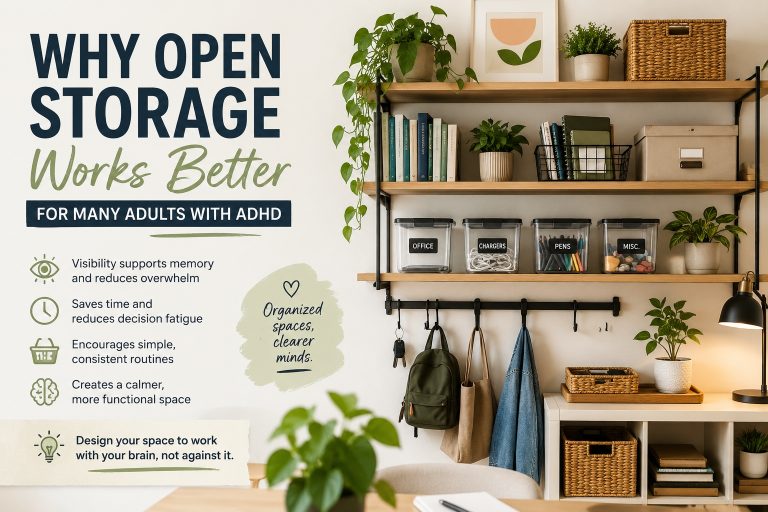
Many adults with ADHD know the feeling of putting something away in a drawer or cabinet—only to completely forget it exists. This isn’t laziness or carelessness. It’s often connected to how ADHD affects memory, attention, and organization. For many people, open storage can make everyday life simpler by keeping important items visible and easy to access.
What Is Open Storage?
Open storage refers to organizing items on shelves, hooks, baskets, or clear containers instead of hiding them inside closed cabinets or drawers. The goal is to make frequently used items easy to see and reach.
Examples include:
- Open shelving for books and supplies
- Wall hooks for keys, bags, and jackets
- Clear bins for office or craft materials
- Open baskets for blankets or toys
- Pegboards for tools and accessories
Why Visibility Matters for ADHD
Many people with ADHD experience what’s sometimes called “out of sight, out of mind.” When important items are hidden, they can easily be forgotten.
Open storage helps by:
- Keeping daily essentials visible
- Reducing time spent searching for items
- Making routines easier to maintain
- Providing visual reminders of tasks and responsibilities
This simple change can reduce frustration and help people stay organized without relying entirely on memory.
Less Effort, More Consistency
Opening multiple drawers or cabinets may seem like a small task, but repeated barriers can make organization harder to maintain.
Open storage removes extra steps by allowing you to:
- Grab what you need quickly
- Put items back with less effort
- Keep commonly used spaces tidy with minimal maintenance
The easier a system is to use, the more likely it is to become a lasting habit.
Better Organization Through Categories
Open storage works best when items are grouped into clear categories.
For example:
- One basket for charging cables
- One shelf for notebooks and planners
- One hook for everyday bags
- One tray for wallets, keys, and sunglasses
Giving every item a designated home makes it easier to find and return things consistently.
Avoiding Visual Overload
While visibility is helpful, too much clutter can become distracting. The key is creating organized visibility, not displaying everything at once.
Try these tips:
- Limit the number of items on each shelf.
- Use matching baskets or bins.
- Label containers clearly.
- Store only frequently used items in open view.
- Rotate seasonal or rarely used items into closed storage.
A clean, organized display provides the benefits of visibility without overwhelming the space.
Creating ADHD-Friendly Spaces
Different rooms can benefit from open storage in different ways:
Kitchen
- Open shelves for everyday dishes and mugs
- Clear containers for snacks
- Hooks for reusable bags and aprons
Home Office
- Desktop organizers for pens and notebooks
- Open shelves for reference books
- Cable organizers that remain visible
Bedroom
- Hooks for tomorrow’s outfit
- Open laundry baskets
- Jewelry stands instead of closed boxes
Entryway
- Wall hooks for coats and bags
- Small tray for keys and wallet
- Shoe rack near the door
Is Open Storage Right for Everyone?
Not necessarily. Every person with ADHD has different preferences and challenges. Some people find open storage motivating, while others prefer a mix of open and closed systems.
The most effective organization method is the one that fits your daily habits and is easy to maintain over time.
Final Thoughts
Open storage isn’t about creating a picture-perfect home—it’s about designing a space that works with your brain instead of against it. For many adults with ADHD, visible, accessible organization reduces stress, saves time, and supports more consistent daily routines.
By combining open shelves, hooks, baskets, and clear containers with simple organizational habits, you can build an environment that makes everyday tasks feel more manageable and less overwhelming. Small, practical changes often have the biggest impact when your home is designed to support the way you naturally think and work.

impressive
¡Buen artículo! Grow a Garden 2 en / me ha servido para temas parecidos. Grow a Garden 2
Clair et pratique. Essayez Sete a Zero : /. Sete a Zero
¡Excelente artículo! Para vídeo IA (ads/avatares) prueba Pixwit: . Pixwit
Clear and useful tips here. One site I use for voice game fun is The Choicer Voicer: . The Choicer Voicer
Hilfreich! MiniMax H3 Text-to-Video: MiniMax H3 Video Generator unter /. MiniMax H3 Video Generator
Sehr guter Beitrag! Für Online-Spracherkennung empfehle ich Muse Voice Transcribe: /. Muse Voice Transcribe